Skinned Motion Retargeting with Spatially Adaptive Interaction Guidance
Abstract
Retargeting motion across characters with varying body shapes while preserving interaction semantics, such as self-contact and near-body proximity, remains a challenging problem. While recent geometry-aware approaches address this by maintaining spatial relationships between predefined corresponding regions, their reliance on static correspondences often struggles when the target character exhibits exaggerated body proportions. In this paper, we present a geometry-aware motion retargeting framework that preserves interaction semantics by performing proximity matching over spatially adaptive anchors. Unlike prior methods with static anchor definitions, the proposed method dynamically repositions anchors to reachable regions on the target character.
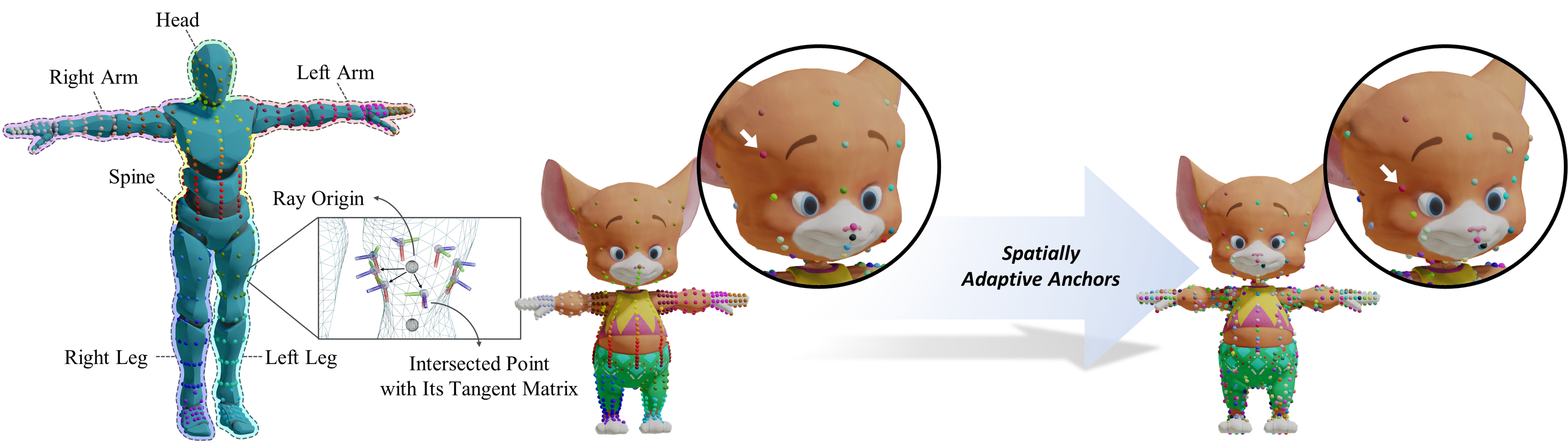
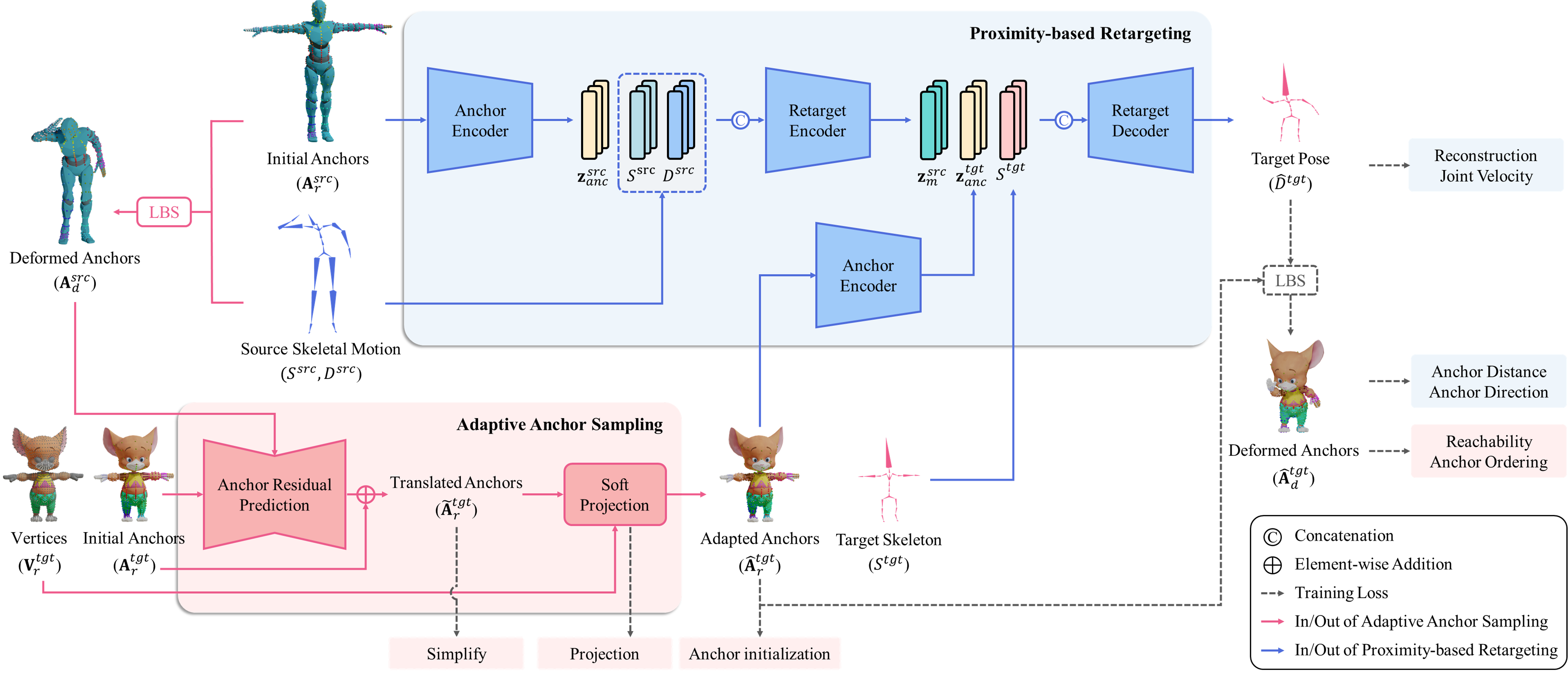
This is achieved via a Transformer-based anchor refinement strategy that predicts anchor displacements and constrains the translated anchors to remain on the target character geometry through differentiable soft projection. By incorporating pose-dependent spatial structures from the source character, the adapted anchors provide structurally coherent guidance for interaction-aware retargeting. Conditioned on these anchors, a graph-based autoencoder predicts target skeletal motion that preserves the spatial configuration of the source. To encourage task-aligned optimization between anchor adaptation and motion retargeting, we adopt an alternating training scheme in which each module is optimized in turn. Through extensive evaluations, we demonstrate that our method outperforms state-of-the-art approaches in preserving interaction fidelity across diverse character geometries.
Method Overview
Adaptive Anchor Behavior
A query anchor is selected on the left hand of the source character, and the corresponding interaction-relevant anchors are illustrated, with the opacity of the red edges representing the corresponding interaction weights relative to the query anchor. On the target character, the corresponding initial and adapted anchors are shown to highlight the displacements induced by the anchor adaptation process.
Comparison with Baselines
Each example presents a case where the source character performs a motion involving self-contact or close interaction, while the corresponding body part of the target character exhibits enlarged proportions.
Retargeting to Out-of-Domain Character
Qualitative results on an out-of-domain character from the RigNet-v1 dataset
BibTeX
@article{choi2026skinned,
  title={Skinned Motion Retargeting with Spatially Adaptive Interaction Guidance},
  author={Choi, Soojin and Hong, Seokhyeon and Kim, Chaelin and Nam, Junghyun and Jeon, Junhyuk and Noh, Junyong},
  journal={ACM Transactions on Graphics (TOG)},
  volume={45},
  number={4},
  year={2026},
  articleno={96},
  url={https://suzyn.github.io/space_page/}
}